Legal Research
AI Legal Research for Czech Law
Search 1.5 million court decisions, the full Czech legislative corpus, and EU law, all in one place. Every answer comes with citations you can verify in one click.
How it works
Ask your legal question in plain Czech
Type your question as you would ask a colleague. No Boolean syntax, no keyword hunting. Aturno understands legal context and intent.
AI searches the full corpus simultaneously
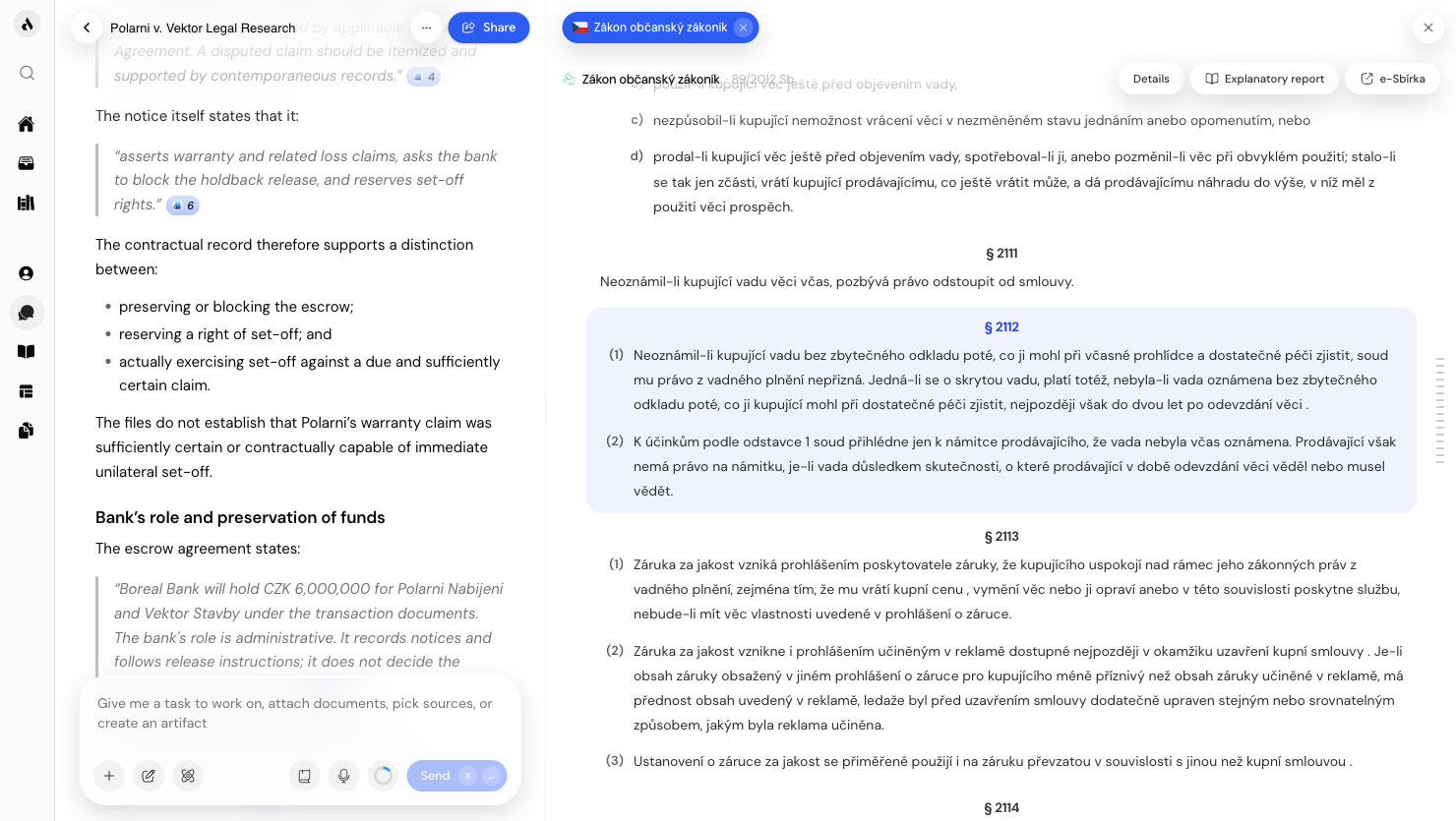
Aturno searches hundreds of thousands of court decisions, the complete e-Sbírka legislative database, and EUR-Lex in parallel, semantic search, not keyword matching.
Receive a cited, synthesised answer
The answer is synthesised from the most relevant sources, with numbered citations linking directly to original decisions and statutory texts. Nothing is invented.
What you can do
Frequently asked questions
Aturno indexes both the full text of decisions and structured metadata. The AI reads and synthesises the full decision text, not just headnotes. You receive answers grounded in the reasoning of the court, not only the operative part.
The judgment database is synchronised with official sources on a regular basis. New decisions published by NSOUD, NSS, and Ústavní soud are typically indexed within days of publication. The legislative corpus tracks e-Sbírka updates in near real time.
Yes. Aturno covers all branches of Czech law including civil, commercial, criminal, administrative, tax, labour, and constitutional law. The NSS database alone provides deep coverage of tax and administrative case law. EU competition law is available via EUR-Lex integration.
Every statement in a Aturno answer is tied to a cited source. The AI does not generate legal analysis without grounding it in real decisions or statutes. You can click any citation number to open the source document. If the AI cannot find a relevant source, it says so.
Official court websites offer keyword search of their own decisions only. Aturno provides semantic search across all Czech courts and the legislative corpus simultaneously, synthesises the results into a written answer, and lets you continue the conversation with follow-up questions, all in one interface.